In Brief:
- What Is GEO?
- Why is GEO Important in 2026?
- How Does GEO Work for AI Search Engines?
- How to Optimize Content for AI Search?
- GEO Vs. Traditional SEO.
- How SEO & GEO Work Together.
- Why is GEO the Future of AI Search in 2026?
- The Key Pillars of Generative Engine Optimization Strategy.
- Substantial Strategies to Win the Generative Search Game.
- Evaluating the Real ROI of Your GEO Activities.
- Who Should Use Generative Engine Optimization (GEO)?
- Why GEO Matters for Future Search Visibility!
TL;DR: Generative Engine Optimization (GEO) is becoming the deciding factor for visibility across AI Overviews, ChatGPT, Copilot, and Perplexity as AI-powered search reshapes discovery. This guide explains what GEO is, how it works, and the key differences from traditional SEO. Combining SEO and GEO is what keeps brands visible as AI search matures through 2026.
Why Generative Engine Optimization (GEO) Is the Future of AI Search in 2026!
Generative Engine Optimization (GEO) is emerging as a critical strategy. It enables visibility in - AI-powered search engines. AI-driven search engines include - Google AI Overviews, ChatGPT, Copilot, and Perplexity.
This is unlike traditional SEO. SEO focuses on rankings and links. GEO precisely optimizes content. So, AI systems can - understand, extract, and cite it directly in generated answers.
Search engines are shifted from blue links to synthesized responses. So, GEO is becoming more essential.
By 2026, businesses that fail to - optimize for AI-driven search risk losing visibility. This is likely even if they - rank well in traditional search results.
What Is GEO?
Generative Engine Optimization (GEO) structures - digital content for AI-powered search. It helps search engines interpret information with clarity. GEO ensures content can be summarized accurately in responses.
GEO makes digital material easy to reference in conversations. It values semantic clarity over keyword stuffing. It emphasizes structured data and authoritative sources.
GEO tailors content for AI-powered search engines. Platforms like Microsoft Copilot rely on GEO. It is different from SEO.
- GEO makes content machine-readable. Traditional SEO focused on keywords. GEO emphases AI-generated answers.
- SEO is about rankings. However, GEO is about visibility in AI responses. AI search engines synthesize knowledge. Large language models offer conversational answers.
- GEO ensures content is structured. Without GEO, content risks invisibility. GEO will be a core strategy in the coming time. Businesses adopting GEO gain AI visibility.
Why is GEO Important in 2026?
AI-powered search - will dominate discovery. Users will rely on engines that generate answers, not rank pages. Platforms like Google AI Overviews, ChatGPT, and Perplexity lead this shift.
Traditional SEO signals lose importance in this landscape. AI engines summarize and deliver responses directly. GEO ensures your content is chosen as a trusted source. It positions your brand within AI-generated conversations.
GEO is essential in 2026 because:
- AI-generated answers are replacing traditional rankings.
- Visibility depends on context, structure, and credibility.
- Brands must optimize for AI citations, not just clicks.
- Generative search traffic is growing rapidly.
How Does GEO Work for AI Search Engines?
AI-powered search engines rely on - large language models (LLMs). They generate direct answers - instead of showing lists of links.
This changes how users access and consume information online. GEO makes content discoverable within these AI-driven responses. It ensures information is - clear, usable, and trusted by search engines.
Here is how GEO works step by step:
- AI engines retrieve relevant content. Language models scan trusted sources for structured, authoritative information.
- GEO-optimized content is selected. Clear headings, semantic clarity, and contextual depth help AI choose content.
- Information is synthesized into answers. AI generates summaries and cites high-quality sources.
- Google AI Overviews amplify GEO impact. Well-structured GEO content is more likely to appear in AI Overviews.
- AI Engines Generate Answers. LLMs create synthesized responses. Retrieval methods add context.
- GEO Ensures Discoverability. GEO structures content clearly. AI systems can surface it easily.
- Usability in AI Outputs. GEO makes content usable. It adds context and authority.
- Role of AI Overview Optimization. Google AI Overview uses GEO. Other platforms depend on it too.
- GEO Tools for AI Search. New GEO tools are emerging. They are helping businesses adapt fast.
- Strategic Importance of GEO. GEO is not optional. It is a future-proof strategy.
How to Optimize Content for AI Search?
Optimizing content for AI search needs a new approach. Traditional SEO methods don't work. Keywords alone cannot drive visibility.
Content must be machine-readable for AI systems. It should be semantically rich. Authority makes content trustworthy for AI engines. GEO-friendly content focuses on clarity and structure. Credibility ensures content surfaces in generative responses.
Steps for Businesses and Content Creators:
- Structure content: Leverage headings, short sentences, and clear formatting.
- Apply semantic markup: Tag entities, relationships, and metadata.
- Leverage AI search optimization services: Partner with GEO-focused agencies or platforms. They must specialize in aligning content with - generative search outputs.
- Create authoritative content: Prioritize depth and trustworthiness. So, AI engines recognize your content - as a reliable source.
- Use a GEO-friendly checklist: Ensure every piece of content meets benchmarks. They must enable - readability, semantic clarity, and AI visibility.

Make Your Content Work Twice as Hard
GEO Vs. Traditional SEO.
Comprehending the difference between SEO and GEO is key to creating a strategy addressing traditional search engines and AI-driven platforms.
Explore difference between GEO vs traditional SEO:
A) How Target User-Base Phrases Their Searches.
- GEO: On generative AI, queries sound conversational. You might ask, "What are the best hotels in New York to stay?"
- SEO: Traditional SEO relies on phrasing. On Google, you would type "best hotels in New York" to get results.
B) How Information and Insights are Delivered.
- GEO: Generative Engine Optimization Strategy aims for direct responses. It summarizes topics and shares source links. Generative engines focus on concise answers to appear in results.
- SEO: Traditional search engines show multiple options. Users pick what seems most relevant. SEO delivers useful articles. The main goal is to rank pages for queries.
C) How Results and Outcomes are Showcased.
- GEO: Generative AI uses - keywords, brand mentions, and context. Well-structured pages improve visibility. AI bots must crawl. And extract data to show relevant content.
- SEO: Traditional search engines rely on - keywords, backlinks, and relevancy. User engagement also matters. Longer dwell times - signal relevance and boost rankings.
How SEO & GEO Work Together.
GEO and SEO complement each other. SEO builds online visibility. GEO adds AI-focused optimization. Both share similar fundamentals. Together, they form a stronger digital strategy. Integrating GEO with SEO boosts ranking and reach.
Consistent GEO and SEO.
- Blending GEO and SEO boosts visibility.
- It enhances engagement across AI & traditional search.
Unified Strategies.
- Integration needs quality content.
- Strategic keywords guide AI and SEO.
- Technical optimization supports performance.
- Adaptability keeps pace with evolving trends.
Localized Approaches.
- GEO can target local queries.
- It backs national and global SEO.
- Voice search benefits from GEO.
- Cultural relevance strengthens content reach.
Why is GEO the Future of AI Search in 2026?
Generative Engine Optimization Strategy is turning into a substantial element of digital strategies. This is because AI platforms transition how users search for insights. Here is why GEO is substantially more than ever:
1) Advancing Organic Search Visibility.
AI is transitioning organic search. As per Gartner, the traditional search volume will drop by 25 percent, and organic search traffic is projected to drop by more than 50 percent as users switch to AI-powered search.
However, traditional SEO isn't sufficient, as most of the customers are anticipated to leverage AI-powered search in the subsequent year.
And around 70 percent already rely on AI-generated outcomes. Brands must include GEO tactics to entice and capture consumers' attention effectively.
2) Developing Brand Authority.
Brand authority is quite vital in 2026. AI-powered platforms will influence how users view and rely on companies. GEO builds your brand as a trusted source in the era of AI.
As per the latest research, 70 percent of Gen Z users rely on Gen AI platforms to assist them in making decisions. And showcase how these tools influence user trust. Likewise, businesses with AI-optimized content are seen as advanced and consistent.
3) Adjusting to Altering Search Conducts.
GEO is significant as AI-driven search alters how users locate and use information. More people are initiating their searches on AI platforms.
For instance, ChatGPT has millions of active users. Also, Perplexity AI's search volume has augmented in the past year. They are reaching millions of active users.
This showcases the upsurging trust in AI to offer insights. As AI usage has increased, users turn to Perplexity AI and ChatGPT.
4) Gaining Insights Through Data Sets.
Data plays a critical role, and GEO empowers businesses to use these insights suitably. Comprehending user behaviour is key to building efficient strategies when AI platforms create personalized recommendations.
As per research, 84 percent of digital marketers say data quality steers marketing success, and AI-powered platforms meaningfully enhance predictive analytics. It determines how a generative engine optimization can convert user potential with content.
The Key Pillars of Generative Engine Optimization Strategy.
GEO comprises a multi-step approach to make sure content aligns with the budding abilities of Gen AI platforms. Let us discuss how GEO really works:
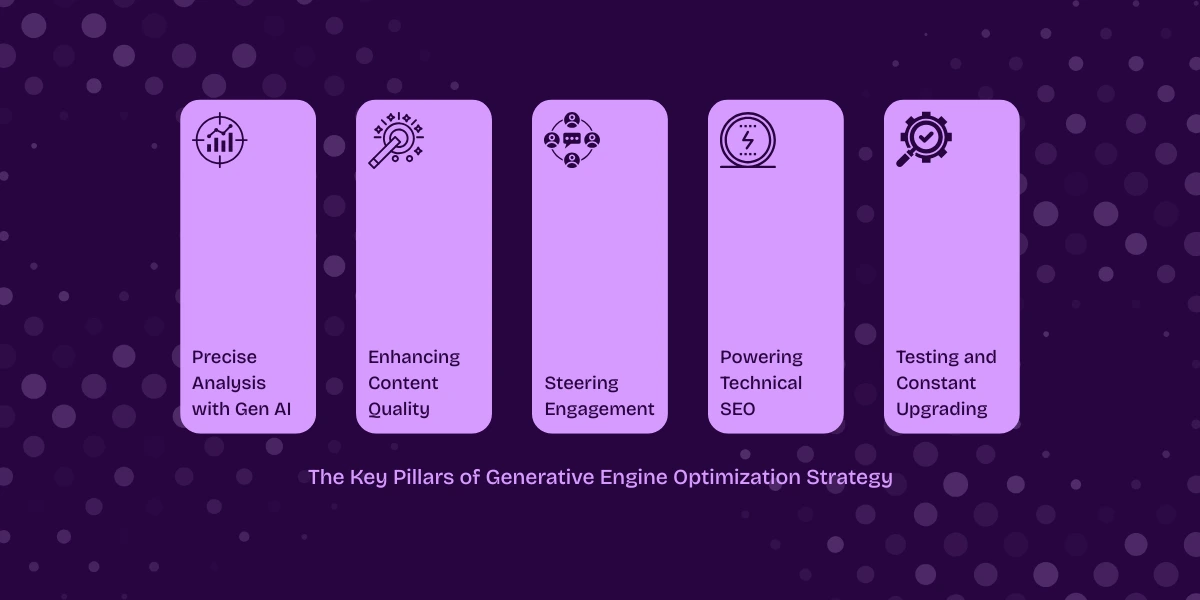
A) Precise Analysis with Gen AI.
Gen AI research is based on GEO. It offers vital insights about keyword tactics, structure performance, content ranking, and the viable landscape. You can enhance your GEO tactics by comprehending how AI solutions prioritize and engage with content.
Improve GEO Strategies:
- Apply target long-tail keywords.
- Use conversational phrases.
- Identify key queries and response formats.
- Study the strategies of businesses in AI search results.
- Understand how AI platforms perceive your brand.
- Refine reputation with clear, trusted content.
- Match AI-preferred types and structures.
- Ensure visibility with context-rich material.
- Adapt to evolving AI response and citation patterns.
B) Enhancing Content Quality.
GEO augments your content by aligning with the precise criteria that AI algorithms use to regulate relevancy.
Significant Aspects to Consider when Optimizing Content are:
- Address queries with relevant information.
- Use semantically aligned keywords for intent.
- Provide detailed answers for AI prioritization.
- Create guides, articles, and interactive content.
- Update content regularly to stay fresh.
- Build credibility with citations and sources.
C) Steering Engagement.
Generative engine optimization boosts the impact of your content. In this AI era, content delivery is not merely about making your content live. However, even placing it in important locations makes it easy for AI systems to line up.
Executing these key strategies:
- Share content on Reddit and Quora.
- Influence AI responses with active participation.
- Encourage testimonials.
- Boost trust with social media posts.
- Share content to expand reach.
- Drive AI engagement through social platforms.
- Build a strong brand community.
- Generate fresh content to improve visibility.
D) Powering Technical SEO.
GEO blends with traditional technical SEO techniques to ensure your website is technically precise. This is necessary for it to be ranked by AI-driven algorithms.
The significant elements comprise:
- HTML tags structure content.
- Add titles, meta descriptions & headers.
- Ensure mobile responsiveness.
- Compress images and pictures.
- Use browser caching and optimize code.
- Fix crawling and indexing issues regularly.
- Enable search engine indexing.
- Use HTTPS for security.
E) Testing and Constant Upgrading.
GEO will keep altering, so digital marketers must be highly creative.
Here is how to remain updated:
- Experiment with videos.
- Test content with A/B methods.
- Improve visibility by adapting to AI trends.
- Monitor engagement closely.
- Enable strategies with data-steered decisions.
- Stay updated through blogs.
- Join communities to learn about AI and GEO.
- Keep evolving with new insights.
Substantial Strategies to Win the Generative Search Game.
Implementing GEO needs to focus on AI platforms. Content must align with user intent. GEO ensures interaction with generative engines. Steps help start optimization effectively.
1. Answering Questions Clearly in Content.
- Generative engines deliver summaries.
- Optimize content like feature snippets.
- Provide brief, factual, and clear answers.
- GEO gives AI systems direct knowledge.
2. Supporting Content with Facts & Data.
- Generative engines need accurate information.
- Citations and sources build credibility.
- Use facts, figures, and case studies.
- This improves ranking and authority.
3. Optimizing for Natural Conversations.
- Users search with conversational questions.
- Content must answer these directly.
- Queries often sound like human dialogue.
- Optimize for natural phrasing to appear.
4. Strengthening Your Brand Presence.
- Generative AI favours reputable brands.
- Build recognition beyond your website.
- Encourage reviews and external content.
- Strong brands appear more in AI results.
Evaluating the Real ROI of Your GEO Activities.
Gauging the success of GEO is critical to comprehend its effect on your business. You can refine strategies for enhanced outcomes through it. Here are two areas to emphasis on:
A) Tracking KPIs
Monitor key performance indicators for GEO success.
- Analyse impressions; some show 30% enhancement.
- Track traffic and conversions.
- Use EEAT (Experience, Expertise, Authority, Trust).
- Monitor metrics for reach.
B) Using Tools for GEO Analysis
Leverage the right tools to measure GEO success.
- HubSpot's AI Search Grader gives advanced tips.
- Optimize content for AI platforms.
- Analyse user behaviour to - refine strategies.
- Blend free and paid tools for insights.
Who Should Use Generative Engine Optimization (GEO)?
GEO is not just a buzzword. It is a strategic approach for modern businesses. GEO helps brands stay visible in AI-powered search. Every brand can benefit from GEO practices. It is especially valuable for -
1. SaaS Companies.
- SaaS products thrive - on discoverability.
- GEO ensures content interpretation by AI search engines. This content comprises - product features, use cases & documentation.
- This helps potential customers receive AI-generated summaries. This content highlights your strengths.
2. Digital Marketing Agencies.
- Agencies must adapt to AI search.
- Traditional SEO is not enough.
- GEO helps agencies future-proof client strategies.
- It focuses on semantic clarity over keyword density.
- Structured data becomes the foundation of visibility.
- GEO builds authority in AI-powered search results.
- Agencies gain leadership in next-generation optimization.
3. Enterprise Brands.
- Complex offerings need precise explanations. GEO simplifies enterprise solutions.
- It ensures summaries resonate with decision-makers.
- Clear content builds credibility in markets.
- GEO strengthens authority across industries.
- Trust grows when AI delivers helpful insights.
- Enterprises gain visibility using GEO.
4. Businesses and Publishers.
- Media outlets depend on visibility.
- GEO helps their content surface in conversational AI responses.
- Authoritative content increases trusted citations.
5. Companies Targeting AI-Driven Search Traffic.
- Any business aiming to capture traffic from AI platforms must embrace GEO.
- GEO ensures content is discoverable and usable.
- This creates brand presence directly. GEO drives user conversations with AI.
Why GEO Matters for Future Search Visibility!
Generative Engine Optimization is no longer optional. AI platforms are redefining how users search. They are also changing how people consume information. So, GEO decides which brands stay visible. It also determines which brands get ignored.
At NotionX, we guide businesses through this shift. We build strategies aligned with AI search behavior. GEO frameworks ensure long-term generative visibility. This keeps brands discoverable across AI-powered platforms. Connect with our experts to design a GEO strategy for long-term growth.
Sources & Citations
- Gartner: Data regarding traditional search volume dropping by 25 percent and organic search traffic declining by more than 50 percent as users shift to AI-powered search. [https://www.gartner.com/en/newsroom/press-releases/2024-02-19-gartner-predicts-search-engine-volume-will-drop-25-percent-by-2026-due-to-ai-chatbots-and-other-virtual-agents]
- Salesforce Research: Data regarding 84 percent of digital marketers saying data quality steers marketing success. [https://www.salesforce.com/news/stories/marketing-trends-ai-data/]
Quick Answers
What you need to know about GEO and AI search in 2026
Generative Engine Optimization (GEO) is the process of optimizing content so AI search engines like Google AI Overviews, ChatGPT, and Copilot can understand, trust, and cite it in generated answers.
GEO is important because Google AI Overviews shows summarized AI answers instead of links. GEO-optimized content increases your chances of being included as a trusted source.
GEO uses clear structure, direct explanations, and authoritative context, making it easier for AI models to extract and reference your content.
Yes. Traditional SEO targets rankings and clicks, while GEO targets visibility and citations inside AI-generated responses.
Yes. GEO helps your content get recognized and referenced by AI platforms like ChatGPT, Perplexity, and Google AI Overviews.
Content with clear definitions, FAQs, comparisons, and expert insights performs best because AI systems prefer structured and factual answers.